Monday, 30 January 2017

Fairy Dell

 Fairy Dell


Fairy Dell in one of the most well known birding hotspots in the Bairnsdale area.  Located approximately 30 minutes from Bairnsdale, it is easily accessible by most vehicles. There is a picnic ground with toilet facilities.

To get to Fairy Dell, drive towards Bruthen from Bairnsdale, at Wiseleigh, ( about 3 Km before Bruthen), there will be a sign that will direct you towards Fairy Dell, along the Deep Creek Rd. The route is well sign posted from here.

Rose Robin

Juvenile White-Naped Honeyeater
Spotted Pardalote

There are two walks at Fairy Dell that connect with each other half way along.  The first track takes you along the ridge, which is a much drier environment.   Birds such as White Throated Tree Creeper, Spotted Pardalote, Common Bronzewing and Wonga Pigeon are common along along this track. The second walk runs through lush wet habitat, where Rose Robin, Rufous Fantail, Black Faced Monarch, Brown Gerygone, and Lyrebird can be seen. The best tactic to use is to walk 15 or 20 metres, and then stop and listen for 5 minutes or so. Eastern Whipbirds are often quite inquisitive, and will come up close for a look.

The ebird Hotspot can be seen here.  http://ebird.org/ebird/australia/hotspot/L2551342

The walking track in Fairy Dell- Google Maps
Some unusual sightings include Pink Robin, Speckled Warbler, White Bellied Cuckoo Shrike, Beautiful Firetail have been seen at Fairy Dell.  Powerful and Sooty Owl have also been seen here occasionally, so keep an eye out for roosting birds.


Fairy Dell walking track

The bridge over the creek
Fairy Dell is probably one of the best places to go birding in the western part of East Gippsland. The range of birds is very similar to Cabbage Tree Flora Reserve, but the easy access and closeness to Bairnsdale makes Fairy Dell a must visit birding stop.

Saturday, 28 January 2017

Macleod Morass

Macleod Morass

Macleod Morass is a 520 hectare freshwater marsh, located just south of Bairnsdale. The morass abounds with wildlife, particularly water birds. Macleod Morass is an internationally recognized Ramsar site.

To get to Macleod Morass, drive down Forge Creek Rd, and turn left onto Bosworth Rd at the roundabout near Vegco. drive down a steep hill, and the morass is on your right. The bridge over the creek is currently closed, so there is no access from the other side. There is a large car park area, so parking is never any problem. It should be noted that Macleod Morass is a game reserve, so be aware of whats going on around you during duck season. 

Darter

Royal Spoonbill

There are two bird hides at Macleod Morass. One is on a board walk on the left of the main track that runs through the morass. The second hide is at the end of a 420 metre board walk that runs out towards the centre of the morass.
Macleod Morass

Birds that can be seen at Macleod Morass are: Spoonbills, ibis, Swamp Harrier, Australasian Swamphen, a variety of duck species, cormorants, Darter and Little Grass Bird. A complete list can be seen here. http://www.birdlife.org.au/images/uploads/branches/documents/EG_Macleod_Morass_Bird_List_Brochure.pdf

The main track going though the morass

Black swans

The start of one of the walks

Monday, 9 January 2017

Cape Conran Coastal Park

Some birds of Cape Conran Coastal Park

Cape Conran Coastal Park is a 11,700-hectare national park situated between Marlo and Bemm River. Over 250 bird species have been sighted in the park, including species such as Eastern Ground Parrot, Topknot Pigeon, White Headed Pigeon and Southern Emu Wren.  This post will look at some of the best sites in Cape Conran Coastal Park. 

Cape Conran Boat Ramp.

Google Maps
The Cape Conran boat ramp is located on the western side of Cape Conran on the West Cape Rd. Pacific Gull, Silver Gull, Sooty Oystercatcher, Australasian Gannet and Bassian Thrush are often seen here.  Look for Bassian Thrush and Eastern Whipbird in the scrub behind the boat ramp, and keep and eye out for Sea Eagles passing overhead.

Silver Gulls at Cape Conran


Cape Conran

Yeerung River. 

Google maps
The Yeerung River Estuary View Walk is a heathland and coastal scrub walk. The walk is on the right side of the road just as you cross the bridge on the Yeerung River.  The Ground Parrot has been flushed from here, and Southern Emu Wrens are common. Other bird that can be seen here are: Beautiful Firetail, Rainbow Lorikeet, Azure Kingfisher in the Yeerung River and many types of honeyeaters.
Yeerung River looking downstream

Heathland

Looking towards the ocean over the heath

Old Coast Road

The Old Coast Rd has potential for Brush Bronzewing, Southern Emu Wren, Sacred Kingfisher, (in Summer) and Turquoise Parrot. Look for Southern Emu Wren in the heathland adjacent to the road, and pay attention for their high pitched calls. Since the Old Coast Road is quite long, a good method for birding there is to drive slowly down the road, stopping at any spot that looks to have potential for birds, such as a creek or heathland. 
Old Coast Rd
Old Coast Rd
Brush Bronzewing


Wednesday, 4 January 2017

Nowa Nowa Birding

Nowa Nowa Birding


Nowa Nowa is a small town about 20 Km north-east of Lakes Entrance and is on the main road between Orbost and Lakes Entrance. It has a population of approximately 140 * , with a general store/Post Office and a few caravan parks. The East Gippsland Rail Trail runs through Nowa Nowa, where it crosses Boggy Creek. 

Nowa Nowa is an excellent location for birding. There is a wide range of habitat, from the drier more open forest to the swampy areas around  the boat ramp.  Approximately 120 bird species have been seen in the Nowa Nowa area.

Boggy Creek Gorge

Boggy Creek Gorge is a large gorge upstream of the Nowa Nowa bridge. There is a walking track and lookout overlooking the gorge. The walking track and lookout are accessible from the Bruthen-Buchan Road. Turn into the car park opposite the saw mill. About 30 bird species have been seen there so far, but there is a lot of potential for more species.
Boggy Creek Gorge


Nowa Nowa Township

Nowa Nowa itself is a great spot for birds. Masked Lapwings are a resident beside the highway, as  is a large family of Wood Ducks. Welcome Swallows, wattlebirds, Magpies and Kookaburras are abundant, while White Throated Needle Tail can be seen during the summer months.


Nowa Nowa Wetland Walk

The Nowa Nowa wetland walk is an excellent spot for birds. Black Fronted Dotteral, Azure Kingfisher and  many honeyeaters and cormorants live in the wetlands bordering Boggy Creek. You can access the walk by driving down Launching Rd, to the boat ramp. The walk follows Boggy Creek downstream, and is well sign posted.

Nowa Nowa Walk

Reed Warbler, seen near the Nowa Nowa boat ramp

Female Rufous Whistler, Nowa Nowa Walk

Nowa Nowa is indeed a great birding location. It should be quite easy to see forty species within a couple of hours, and with such a central location, Nowa Nowa is a must visit for a birder.


* https://en.wikipedia.org/wiki/Nowa_Nowa%2C_Victoria

Tuesday, 13 December 2016

Birding around Burnt Bridge, Cherry Tree

Burnt Bridge, Cherry Tree Birding.

Burnt Bridge and Cherry Tree are located on the eastern arm of Lake Tyres, approximately 15 minutes from Nowa Nowa. Access is via Princes Hwy, between Lakes Entrance and Nowa. Take the Burnt Bridge Road, and then continue straight, or turn left on to Cherry Tree Road, depending on whether you are going to Burnt Bridge or Cherry Tree.  There is a 1.1 KM walking track between Burnt Bridge and Cherry Tree, which follows the river. The environment is quite moist in most places, with some thick tea-tree, as well as larger trees.

Map of Burnt Bridge and Cherry Tree Area.


With such a diverse environment, birds are plentiful, with herons, pelicans, Sea Eagles, Eastern Whipbirds, and Rose Robins. http://ebird.org/ebird/hotspot/L2986658

White Faced Heron

Pelican

Azure Kingfisher

Rose Robin, male
Cherry Tree and Burnt Bridge and the walk between is a great location for birds, as well as fishing or a picnic. It should be noted however, that the road in can be quite rough at times, so small cars may have difficulty.

Saturday, 19 November 2016

Marlo

Marlo


Marlo is a small town located where the Snowy River flows into the ocean. It is a popular holiday and fishing spot, and can be quite busy in the holiday season. There is a small tidal estuary with a large area of mudflats, the ideal habitat for waders. The area is well know for birds, with the estuary being home to a number of the endangered Hooded Plovers. There is also a lone Beach Stone Curlew, and having never seen one before, a visit was necessary.

To get to the area of beach that I wanted, you have to drive down the Corringle Rd, towards "The Slips",  and then walk approximately 2 Km along the beach to reach the entrance. The walk to the Marlo Entrance was devoid of any birds, except a Pied Oystercatcher or two.  After arriving at the entrance we set up the spotting scope, using some drift wood as cover.  From there, we had a wide view of the estuary, and we could see many Pied Oystercatchers, Red Capped Plovers and the Little tern colony. The tide was just beginning to come in again, ideal conditions for waders. 


However, there was still no sign of our main target, the Beach Stone Curlew, and after half an hour or so, had given up. Then, I was scoping the Marlo side of the lake, when out of the debris, stepped the Beach Stone Curlew! I was surprised at how large he was, and also how well camouflaged. The dull brown and grey colour blended in perfectly with the surrounding habitat.  He stood perfectly still, while a person and a dog walked past, and stayed in the same spot for the entire 2 hours we were there.  
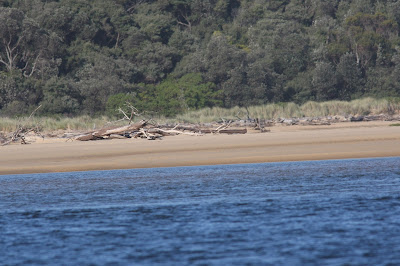
The Beach Stone Curlew is in front of the debris

We continued looking for birds, but didn't find many.  There were less waders than expected, but we didn’t check French Narrows, so there may have been more in there. The Crested Terns were abundant, as were juvenile Pacific Gulls. All up, we saw twelve species, Checklist

On the walk out, we found a dead Short Tailed Shearwater on the beach, another lifer. Other than that, and an Pied Oystercatcher, not a single bird was seen on the beach between the Marlo Entrance and The Slips.

The Marlow trip was definitely worth it, with three lifers, ( Beach Stone Curlew, Little Tern and Short Tailed Shearwater), and many other birds as well. The weather and tide was perfect, and it was a shame that there was not more waders around. Will definitely have to go back, and perhaps explore the French Narrows are.

Sunset at Marlo

Sunday, 6 November 2016

Hollands Landing

Hollands Landing

 Though technically not in East Gippsland Shire, Hollands Landing is very close, so I have decided to include this post on this blog. Hollands Landing is a small community of houses, a caravan park and a wharf. It is at the north-eastern end of Mclennan straight, a narrow channel of water that connects Lake Wellington with the rest of the Gippsland Lakes.

According to eBird, 119 bird species have been seen at the Hollands Landing hotspot, and no doubt other species have been sighted too. Victoria Lagoon, which is a large lagoon behind Hollands Landing is also abounding with birds.
Hollands Landing as seen from Google Maps

Many birds frequent Hollands Landing and the surrounding area. Black Swan, spoonbills, a variety of terns and waders are common here, particularly at Victoria Lagoon. Occasionally Banded Lapwings are reported, and this was the reason for my visit last week.

I had received a needs alert of a Banded Lapwing at Hollands Landing, from eBird a few days prior to my visit. Having never seen a Banded Lapwing, and knowing that they are uncommon in the area, plans were immediately made for a visit.

Friday 4th November was a warm windy day, not ideal for seeing birds, and I had little hope of sighting the Lapwings. However, two were seen in a paddock, just before Hollands Landing, as were 2 Black Winged Stilts, lots of Australasian Pipits and numerous Australian Shelducks.

Banded Lapwings

The two Banded Lapwings camouflaged extremely well in the brown grass, and had it not been for their white front, they would have evaded notice. They are considerably smaller than the more common Masked Lapwing, and in my opinion, much prettier. 

I then continued on to Hollands Landing, and not finding many birds about turned down a lane that led to Victoria Lagoon. The wind was very strong by this time, and I didn't hold much hope of seeing any waders. However, there were several Red Capped Plovers, a few Red Necked Stints, and four Curlew Sandpipers feeding on a small spit of land approximately 250 metres away. The long distance and shimmer made it impossible for photos, but I managed to get a few of the landscape.


Hollands Landing certainly turned out to be a worthwhile visit, though better weather would certainly make it a lot better. No doubt as the summer comes closer, more waders will congregate on the mudflats of Victoria Lagoon and Hollands Landing, making this a must visit place.